Introduction
If you are considering entering the polyurethane (PU) faux stone wall panel market—or looking to upgrade your existing production capabilities—understanding the complete manufacturing process is the first and most critical step toward making an informed decision.
PU faux stone panels have gained massive popularity worldwide as a lightweight, cost-effective, and highly realistic alternative to natural stone. They offer superior weather resistance, thermal insulation, and design flexibility while weighing only a fraction of real stone. But what truly sets successful manufacturers apart is not just the final product—it is the production process behind it.
This guide walks you through every stage of PU faux stone wall panel production, from raw material preparation to final quality inspection. Whether you are a startup exploring your first production line or an established manufacturer seeking to optimize operations, this step-by-step breakdown will help you understand what it takes to produce high-quality panels consistently.

Step 1: Raw Material Preparation and Formulation
Every great product starts with great ingredients. The production of PU faux stone panels begins with the precise formulation of polyurethane raw materials.
The core materials include:
These components must be measured with extreme precision. Even slight deviations in the formulation can affect the panel’s density, hardness, color consistency, and overall quality. This is why professional production lines rely on automated metering systems rather than manual weighing.
Equipment note: This stage requires high-precision dosing and mixing equipment. Both high-pressure and low-pressure foaming machines can be used, but high-pressure systems generally offer better mixing consistency and foam uniformity.
—
Step 2: Mold Preparation and Release Agent Application
Before any material is poured, the molds must be properly prepared. This is one of the most detail-sensitive steps in the entire process.
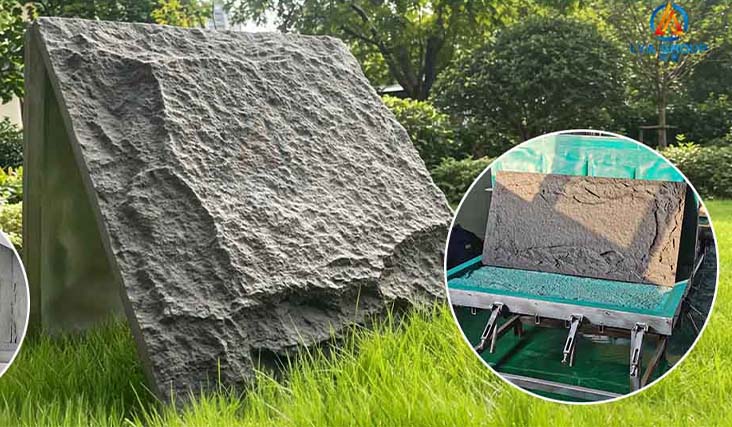
PU faux stone panels are typically produced using specially designed molds that replicate the texture, grain, and surface details of natural stone. These molds can be made from aluminum, silicone, or polyurethane materials themselves.
The preparation process involves:
The release agent is critical: it ensures that the finished panel can be cleanly removed from the mold without sticking, tearing, or damaging either the product or the mold itself. In automated production lines, this step is often handled by robotic spray systems for consistency and efficiency.
—
Step 3: Material Injection (Pouring/Casting)
With the mold prepared, the polyurethane mixture is now ready to be introduced into the mold cavity.
The mixed PU material—in liquid or semi-liquid form—is injected or poured into the mold under controlled pressure. This is where the choice between high-pressure and low-pressure foaming equipment becomes particularly relevant:
The injection must be carefully controlled to fill the mold uniformly, ensuring that every corner and detail of the stone texture is accurately captured. Automated systems use PLC controls and sensors to monitor and adjust the flow rate in real time.
—
Step 4: Curing and Shaping
Once the material is injected, the mold is closed and the curing process begins.
During this stage, the polyurethane undergoes a chemical reaction that transforms it from a liquid into a solid, stable panel. The curing process requires:
Proper temperature control during curing is essential. If the temperature is too low, the material may not cure fully, resulting in weak or deformed panels. If it is too high, the panel may become brittle or develop surface defects. Modern production lines use integrated temperature control systems to maintain optimal conditions throughout the curing phase.
—
Step 5: Demolding
After the curing cycle is complete, it is time to remove the finished panel from the mold.
Demolding must be performed with care and precision. The panel, while now solid, can still be damaged if removed too forcefully or improperly. The release agent applied in Step 2 plays a crucial role here, allowing the panel to separate cleanly from the mold surface.
In automated production lines, robotic arms or mechanical extraction systems handle the demolding process, ensuring consistent, damage-free removal while also protecting the molds from wear and tear.
—
Step 6: Edge Trimming and Finishing
Once demolded, the panel typically requires some finishing work.
The edges of the panel may have slight irregularities, burrs, or excess material from the injection process. These are removed through:
This step is important not just for aesthetics—clean, precise edges ensure that panels fit together properly during installation, creating seamless walls with natural-looking joints.
—
Step 7: Surface Treatment and Coating
To achieve the realistic appearance that makes PU faux stone so appealing, the panel undergoes surface treatment.
There are several approaches to surface finishing:
Surface treatments typically include UV-resistant coatings to prevent fading and weathering, as well as protective layers that enhance durability and weather resistance. The goal is to achieve a natural stone look with a depth of texture that is visually convincing—many high-quality panels achieve a realism level of 95% or higher.
—
Step 8: Quality Inspection
Quality control is not an afterthought—it is integrated throughout the production process.
After finishing, each panel undergoes thorough inspection to verify:
Professional manufacturers maintain rigorous pre-shipping inspection systems, with quality checks starting immediately after order confirmation and continuing through every stage of production.
—
Step 9: Packaging and Shipping
The final step is preparing the finished panels for delivery.
Panels are typically:
Proper packaging is essential—PU faux stone panels, while durable, can be damaged by improper handling or exposure to moisture during shipping.
Choosing the Right Production Partner
Now that you understand the complete production process, the next question is: how do you ensure your production line delivers consistent, high-quality results?
The answer lies in choosing the right equipment and support partner. A truly comprehensive solution provider offers more than just machines—they offer:
Whether you choose high-pressure or low-pressure foaming equipment depends on your production scale, budget, and quality requirements. High-pressure systems offer superior foam density and uniformity for large-scale operations, while low-pressure systems can be a cost-effective entry point for smaller producers.
—
Conclusion
PU faux stone wall panel production is a precise, multi-stage process that requires careful attention to detail at every step—from raw material formulation to final quality inspection. Understanding this process is essential for making informed decisions about your production line investment.
The right equipment, combined with proper process control and expert support, enables you to produce panels that are lightweight yet durable, visually stunning yet cost-effective, and consistent batch after batch. Whether you are just starting out or looking to scale up, a clear understanding of the production process is your foundation for success in the growing PU faux stone market.
Are you ready to take the next step? Contact us to learn how our complete PU faux stone wall panel production solutions—including high-pressure and low-pressure foaming machines, custom molds, technical training, and ongoing support—can help you build a successful manufacturing operation.
If you would like more information, please contact us.